
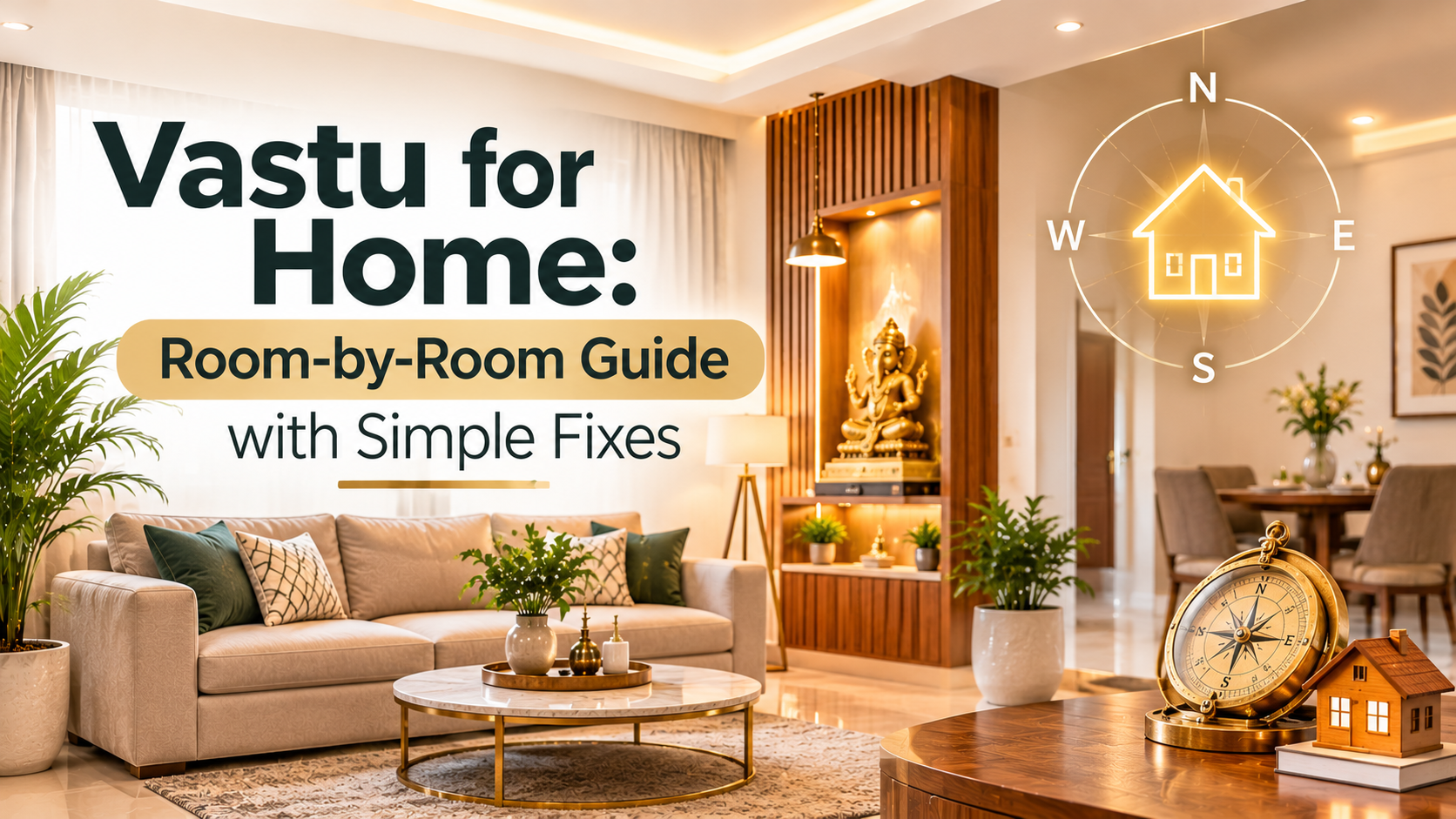
Vastu for Home: Room-by-Room Guide with Simple Fixes
3 November 202613 min readMegha Choudhary
- Quick Summary
- 1. What Is Vastu Shastra?
- 2. The Eight Directions in Vastu for Home
- 3. Vastu for Flats and Apartments
- 4. North, South, East and West Facing Homes
- 5. Main Door
- Common guidelines:
- 6. Living Room
- 7. Kitchen
- 8. Bedroom
- 9. Pooja Room
- 10. Bathroom and Toilet
- 11. Dining Room
- 12. Study Room
- 13. Staircase
- 14. Vastu Colours
- Direction Suggested Colours
- 15. Mirrors and Wall Clocks
- Mirrors:
- Wall clocks:
- 16. Plants
- Considered good:
- Traditionally avoided indoors:
- 17. Wealth and Locker Placement
- 18. Vastu Remedies Without Demolition
- 19. Common Vastu Myths
- 20. Planning Interiors with Vastu for Home
- A simple process:
- Plan a Vastu-Friendly Home
Very few flats in Patna were built with Vastu in mind. The builder decides where the kitchen, toilets and main door go, usually based on the plot and plumbing lines. Yet most families who follow Vastu can still apply it well, because the majority of Vastu guidelines are about placement, colour and use, not walls.
This guide explains Vastu for home in simple terms. You will learn what each direction stands for, how to apply Vastu room by room, what to do in north, south, east and west facing homes, and which fixes work without breaking a single wall. Each section links to a detailed guide when you want to go deeper.
Quick Summary
-
Vastu divides the home into eight directions, each linked to an element and a type of use.
-
The key areas are the main door, kitchen, master bedroom, pooja space and toilets.
-
In flats, most Vastu goals can be met through furniture placement, colours and lighting.
-
No direction is "bad" on its own; what matters is how the space is used.
-
Plan Vastu preferences at the design stage, so they cost nothing extra.
1. What Is Vastu Shastra?
Vastu Shastra is a traditional Indian system of architecture and space planning. It describes how a building's layout, directions and materials can be arranged to support comfort, health and harmony for the people living in it.
Vastu is based on the five elements, called the panchabhutas :
-
Earth (Prithvi): stability
-
Water (Jal): flow and freshness
-
Fire (Agni): energy and warmth
-
Air (Vayu): movement and breath
-
Space (Akash): openness
Each element is linked to a direction. Vastu suggests placing rooms and activities where their element is naturally supported, for example fire-related cooking in the fire direction.
Many guidelines also match practical sense. An east-facing entrance gets morning sun. A kitchen in the south-east gets early light and good air flow. Heavy furniture on the south and west walls helps block the strong afternoon heat, which matters in Bihar's summers.
Whether you follow Vastu strictly, partly or not at all is a personal choice. This guide explains the common principles so you can decide what matters to your family.
2. The Eight Directions in Vastu for Home
| Direction | Element /<br>Deity | Best Used For | Avoid |
|---|---|---|---|
| North (Uttar) | Water /<br>Kubera | Living room, locker facing north,<br>open space | Heavy storage, toilets |
| North-East<br>(Ishan) | Water / Shiva | Pooja space, open and light<br>areas | Toilets, kitchen, heavy<br>furniture |
| East (Purva) | Air / Indra | Main door, living room, study | Clutter, tall heavy units |
| South-East<br>(Agneya) | Fire / Agni | Kitchen, electrical appliances | Bedroom, water tanks |
| South (Dakshin) | Earth / Yama | Heavy furniture, storage,<br>bedrooms | Main door (traditional<br>view) |
| South-West<br>(Nairutya) | Earth / Nirriti | Master bedroom, heavy<br>storage, locker | Toilets, open space,<br>pooja |
| West (Paschim) | Water /<br>Varuna | Dining, children's room, study | — |
| North-West<br>(Vayavya) | Air / Vayu | Guest room, toilets, storage | Master bedroom |
The centre of the home, called the Brahmasthan , should ideally stay open and clutter-free.
3. Vastu for Flats and Apartments
Most Vastu texts were written for independent houses on open plots. Flats need a practical approach.
Use the flat's own entrance, not the building's. The direction of your flat's main door matters more than the direction of the building gate.
Find the centre and directions of your flat. Stand in the middle of the flat with a compass app and mark the eight directions on a floor plan. This becomes your Vastu map.
Focus on the big five: main door, kitchen, master bedroom, pooja space and toilets. These carry the most weight in Vastu. Small details matter far less.
Accept what cannot change. Toilets and the kitchen are usually fixed by plumbing. Instead of breaking walls, adjust what you can: the stove position, bed direction, colours and where heavy furniture goes.
Choose the floor and unit wisely, if you are still buying. Many families prefer east or northfacing entrances, and corner flats with more natural light.
At Dreemofy, Vastu preferences are noted at the first consultation and built into the 3D design, and any changes they need are shown in the quote with 100% pricing transparency, so there are no surprises.
4. North, South, East and West Facing Homes
The facing of a home usually means the direction you face when you step out of the main door.
North-facing homes are considered very good in Vastu, linked to wealth and opportunity. Keep the north area open and light.
East-facing homes are linked to health and growth, as they receive the morning sun. Keep the east side free of tall furniture.
West-facing homes are considered good for steady growth and work well with the right layout. Place heavy furniture along the south and west walls inside.
South-facing homes often worry buyers, but a south-facing home is not bad by itself. The position of the door within the south wall matters more. Vastu divides each wall into sections, and some door positions on the south side are considered favourable.
5. Main Door
The main door is called the "mouth" of the home in Vastu, because it is where energy and people enter.
Common guidelines:
-
East, north and north-east entrances are traditionally preferred.
-
The main door should be the largest door in the home and should open inwards, clockwise.
-
Use solid wood or a strong, good-quality door.
-
Keep the entrance well-lit, clean and free of shoes piled outside.
-
Avoid placing a mirror directly facing the main door.
-
A nameplate, toran or auspicious symbols at the entrance are common traditions.
-
Avoid a toilet or staircase directly facing the main door.
A closed shoe rack inside the entrance keeps footwear out of sight and is one of the easiest Vastu-friendly upgrades.
6. Living Room
The living room is where the family gathers and guests are welcomed.
-
It is best in the north, north-east or east part of the home.
-
Place heavy furniture like the sofa against the south or west wall.
-
Family members should ideally sit facing north or east.
-
Keep the north-east corner light, open and uncluttered.
-
The TV and electronics can go on the south-east wall.
-
Use light, welcoming colours like cream, white, light yellow or soft green.
7. Kitchen
The kitchen represents the fire element, so its direction is one of the most discussed parts of Vastu.
-
The south-east is considered the best place for the kitchen. The north-west is the next best option.
-
The cook should ideally face east while cooking.
-
Place the stove in the south-east corner of the kitchen.
-
Keep the sink and stove apart , as water and fire are opposing elements. If they must be on the same counter, leave a gap or add a small partition.
-
Place the fridge in the south-west, south or west.
-
Avoid placing the kitchen in the north-east or directly under or above a toilet.
In a modular kitchen, the stove position, sink position and storage layout can all be planned to match these guidelines at the design stage.
8. Bedroom
Vastu places the master bedroom where stability and strength are strongest.
-
The master bedroom is best in the south-west .
-
Children's bedrooms work well in the west or north-west.
-
Guest rooms suit the north-west.
-
Sleep with your head towards the south or east . Avoid sleeping with your head to the north.
-
Place the bed so it does not sit directly under a beam.
-
Avoid a mirror directly facing the bed.
-
Keep the area under the bed clean and clutter-free.
-
Use soft, earthy colours like beige, light brown, soft pink or light green.
9. Pooja Room
The pooja space is the most sacred part of the home, and Vastu gives it special importance.
-
The north-east is considered the ideal location.
-
Place idols so that you face east or north while praying.
-
Keep idols slightly above floor level, on a raised platform or wall-mounted unit.
-
Avoid placing the pooja space under a staircase, next to a toilet, or sharing a wall with a toilet.
-
Use white, cream, light yellow or light blue colours.
-
Keep the space clean and well-lit, with a lamp or diya.
-
In small flats, a wall-mounted pooja unit in the north-east of the living room or kitchen works well.
10. Bathroom and Toilet
Toilets are linked to waste and drainage, so Vastu suggests keeping them away from sacred and important areas.
-
The north-west or west is considered the best place for toilets.
-
Avoid toilets in the north-east , the south-west and the centre of the home.
-
The toilet seat ideally faces north or south .
-
Keep the bathroom door closed and the toilet lid down.
-
Use light colours and ensure good ventilation with an exhaust fan.
-
Fix leaking taps quickly; constant dripping is considered a drain on wealth.
In flats, toilet positions are almost always fixed. Focus on what you can control: seat direction during renovation, colours, ventilation and keeping the door closed.
11. Dining Room
-
The west is considered the best place for the dining area. The east and north are also good.
-
The dining table should ideally be square or rectangular, not round or oval.
-
Family members should face east or north while eating.
-
Avoid placing the dining table directly in line with the main door.
-
Keep the dining area well-lit and free of clutter.
12. Study Room
-
The north-east, east or north are considered good for a study room or study corner.
-
Students should face east or north while studying.
-
Do not place the study table directly under a beam.
-
Keep the table clutter-free and the room well-lit.
-
Use light colours like light green, cream or light blue for focus.
13. Staircase
This applies to duplex homes and independent houses with internal stairs.
-
The south, west or south-west are considered good locations.
-
Stairs should ideally climb clockwise , from north to south or east to west.
-
Avoid a staircase in the north-east or the centre of the home.
-
An odd number of steps is traditionally preferred.
-
Avoid using the space under the stairs for a pooja room or toilet. Storage is fine.
14. Vastu Colours
Vastu links colours to directions and elements.
Direction Suggested Colours
North Green, light blue
North-East White, light yellow, light blue
East White, light green, light blue
South-East Orange, pink, light red, peach
South Coral, light red, brown
SouthBeige, brown, earthy tones West
West Blue, grey, white
North-West White, cream, light grey
Room-wise: soft earthy tones for bedrooms, warm light shades for the living room, orange or warm tones for the kitchen, and white or light yellow for the pooja space.
You do not have to paint whole walls. Colour can come from curtains, cushions, rugs or one accent wall.
15. Mirrors and Wall Clocks
Mirrors:
-
Place mirrors on the north or east walls.
-
Avoid mirrors directly facing the bed or the main door.
-
Avoid broken or cracked mirrors.
-
A mirror on a wardrobe shutter can be covered with a curtain at night if it faces the bed.
Wall clocks:
- Hang clocks on the north, east or west walls.
-
Avoid the south wall and avoid placing a clock above a door.
-
Keep clocks working and set to the correct time.
16. Plants
Plants bring life and fresh air into the home, and Vastu has clear preferences.
Considered good:
-
Tulsi: north, north-east or east, ideally in a balcony or near a window.
-
Money plant: south-east.
-
Bamboo plant: east or south-east.
-
Areca palm, snake plant, rubber plant: suited to living areas.
Traditionally avoided indoors:
-
Cactus and other thorny plants.
-
Bonsai, which is linked to stunted growth.
-
Dead or dried plants; remove them quickly.
Most of these plants also handle Patna's indoor conditions well.
17. Wealth and Locker Placement
The north is linked to Kubera, the deity of wealth, in Vastu.
-
Place the locker or safe in the south-west , with its door opening towards the north .
-
Keep the north area of the home clean, open and well-lit.
-
Fix leaks and dripping taps.
-
Avoid clutter in the north and north-east.
-
Keep the main entrance clean and bright.
18. Vastu Remedies Without Demolition
Breaking walls in a flat is expensive, messy and often not allowed by the society. The good news is that most Vastu adjustments need no civil work.
| Situation | Simple Fix |
|---|---|
| Kitchen not in south-east | Place the stove in the south-east corner of the kitchen;<br>cook facing east |
| Toilet in north-east | Keep the door closed, use light colours, ensure strong<br>ventilation |
| Bed facing the wrong way | Rotate the bed so your head points south or east |
|---|---|
| No space for a pooja room | Use a wall-mounted pooja unit in the north-east of any<br>room |
| Main door in a less preferred<br>direction | Keep it bright, clean and well-maintained; add a<br>nameplate and toran |
| Heavy furniture in north-east | Move it to the south or west walls |
| Cluttered centre of home | Clear the centre; avoid heavy furniture there |
| Mirror facing the bed | Move it, or cover it at night |
Some families also use traditional symbols such as a swastik, Om or Vastu pyramids. These are matters of personal belief.
Modular furniture makes these adjustments easier, because units can be planned around a Vastu map before production. Every Dreemofy installation goes through 150+ quality checks, including checking that each unit is fitted exactly as per the approved layout.
19. Common Vastu Myths
-
"A south-facing home is always bad." Not true. The exact door position on the south wall matters, and many south-facing homes are considered favourable.
-
"You must break walls to fix Vastu." In most flats, placement, colour and lighting changes are enough.
-
"Every rule must be followed." Even traditional experts focus on the main areas. Trying to follow every small rule in a flat leads to stress and wasted money.
-
"Vastu means expensive products." Most guidelines cost nothing to follow. Be careful of anyone selling costly "Vastu correction" items.
-
"Vastu and modern design cannot mix." Modern interiors can follow Vastu easily when it is planned from the start.
20. Planning Interiors with Vastu for Home
The cheapest time to apply Vastu is before anything is built. Once modular units are made and installed, moving a stove or pooja unit costs money.
A simple process:
-
Mark directions on your floor plan using a compass from the centre of the flat.
-
List your priorities : which Vastu points matter most to your family.
-
Share them with your designer at the first meeting.
-
Review the 3D design with your Vastu map beside it.
-
Freeze the design before production starts.
If your family consults a Vastu expert, involve them before the design freeze, not after installation.
When Vastu planning is part of a full home project, Dreemofy's 45-day move-in guarantee still applies, so your home is ready within 45 days of design sign-off.
Plan a Vastu-Friendly Home
Vastu for home works best when it is planned with your interiors, not added later. Mark your directions, decide what matters most to your family, and build it into the design from day one. If you want interiors that follow Vastu without breaking walls, book a free design consultation. We will map your flat's directions, plan the layout around them and give you an itemised quote, with no obligation. Every Dreemofy home comes with a 10-year warranty.